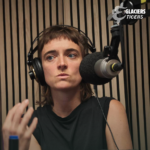

Nia on Immersive Theatre, Real-Time Composition, and Unlearning the Hustle
What happens when theatre stops being a presentation of fixed stories and becomes a collaborative dream architecture where the fourth wall dissolves? In this episode, theatre maker, performer, and facilitator Nia (@nialejander) joins Fabio in the Radio Helsinki studio to explore The Imaginarium — an immersive, collective improvisation score that invites participants into a shared dream state.
Together, they delve into Nia’s transition from social work and Augusto Boal’s Theatre of the Oppressed to choosing art full-time, the mechanics of holding space for spontaneous creation, studying real-time composition with Portuguese master João Fiadeiro, and how collective flow allows us to remember who we really are beneath societal conditioning.
[00:00] Forest Fairy, Clown, and Choosing Art as a Vessel
The conversation begins with Nia’s playful self-description: “Part forest fairy, part clown — with an internal censor freezing everything live on air.”
Nia shares her background in social work, using Augusto Boal’s Theatre of the Oppressed with teenagers in refugee accommodation to explore systemic power and rehearse alternatives to real-world dilemmas. Four years ago, following a pivotal “conversation with the moon,” Nia made the conscious decision to commit fully to art. For Nia, making art is not about personal ego, but about becoming an open channel:
“My main job as an artist is to be a vessel. An instrument, a channel to bring into existence whatever wants to manifest itself. What can I do to create conditions that are beneficial, so that things can manifest through me?”
[01:53] Theatre of the Oppressed
Nia explains Augusto Boal’s participatory format developed in South America, inviting the public to step onto the stage, alter the narrative, and rehearse alternatives to real-world oppression.
[03:34] The Imaginarium: Architecture of a Collective Dream
Shortly after dedicating her life to art, Nia received the vision for The Imaginarium — an experimental, participatory theatre architecture she has staged 20–30 times across different communities.
Rather than imposing a linear script, the Imaginarium is narratively framed as a dream:
- Radical freedom of imagination: Dreams bypass the rational mind’s demand for a conventional “red thread,” opening up space for poetry, absurdity, and spontaneous metaphor.
- The guiding inquiry: At the root of every session sits the quiet question: “What do you want to see in the world?”
- Shared flow state: Creating an environment where a room of strangers can effortlessly slip into a collective creative state.
“When we enter into this flow state, it is not only our small minds, our small human consciousness that is dancing, writing, playing… but we are being danced through, we are being written through.”
[07:15] The Interactive Score: Director’s Chair, Cosmic Scribe, and The Broom
How do you prevent a completely open participatory space from collapsing into chaotic noise? Nia details the physical tools that structure the stage:
- The Director’s Chair: An invitation for anyone to step in and direct the performers in real time.
- The Costume Corner: Physical catalysts for shifting identities and archetypes.
- The Cosmic Scribe: A participant sits as chronicler, typing live observations projected onto the wall to reflect and influence the unfolding action.
- The Broom (The Eraser): A tangible reset button. If the action gets stuck, anyone can sweep the stage to return the space to zero.
- The Dissolving Fourth Wall: In the final 10–15 minutes before the dreamer “wakes up,” the boundary between stage and audience is dismantled completely, turning the entire room into the performance space.
[09:15] Building a Multidisciplinary Crew
While the Imaginarium can run spontaneously from scratch, Nia emphasizes the necessity of an anchored crew to support the infrastructure and hold the container for participants.
Nia’s dream crew brings together diverse disciplines:
- Dancers to bring fluidity and prevent the group from getting trapped in intellectual debate.
- Poets, theatre makers, directors, philosophers, and psychologists, each noticing different threads in the collective fabric.
- Training the crew not with verbal rules, but with an embodied vocabulary to navigate emergent moments — such as grounding someone having a private monologue or weaving disparate impulses into a coherent story.
[14:00] Real-Time Composition: The Secret Rules of Life
While developing the Imaginarium, Nia discovered the work of Portuguese artist João Fiadeiro, who has spent over 25 years in Lisbon researching Real-Time Composition (RTC). After undertaking a five-week intensive training with Fiadeiro, Nia found the engine that powers the inner mechanics of the Imaginarium:
“It’s basically a system of values and principles that support us to enter into a flow state when we practice artistic improvisation in a group. It feels really like he extracted these rules from life.”
When Fabio playfully asks her to name the rules on the radio, Nia laughs: “No, it’s a secret!” — pointing to the experiential truth that certain relational practices can only be learned by doing.
[15:39] Collective Flow as an Act of “Remembering”
Why does collective flow matter so deeply in group improvisation? For Nia, entering these spaces is less about acquiring new techniques and more about shedding social conditioning:
“For me, it’s a lot about remembering. I have a tendency to forget what’s the point, and I have a tendency to forget who I really am. In a way, I feel I can actually only really exist in these kinds of spaces.”
Fabio reflects on how authentic artistic experiences carry an eerie familiarity — not like encountering something alien, but like recognizing a profound truth you had known all along:
“A remembering. Yeah, it’s a very interesting way of seeing things. I resonate with it a lot… some things just seem so obvious that it is as if I had done them before and it’s just me encountering them again. Like, I don’t know, a very good book that you read a long time ago.”
[18:00] Beyond the Loop: The Next Evolution & The 2-Week Residency
After facilitating 20–30 editions, Nia noticed a recurring limitation: starting from scratch with each new group kept the work on an introductory surface level.
To move beyond the introductory cycle, Nia is developing an extended two-week artistic residency:
- Gathering a dedicated 7-person multidisciplinary crew to deeply anchor the principles.
- Culminating in an intimate, 20-person immersive theatre dream.
- Exploring ritual anchors, like the symbol of the dreamer (often a “cosmic egg” or animal totem placed on set).
[20:45] Unlearning the Pushing Mentality: From Hustle to Receptivity
In closing, Nia reflects on a fundamental paradigm shift in how she approaches artistic work and life:
“From capitalism, we are trained to be in this pushing mentality. And I’m trying now to get more into a receiving state — to be open. When people approach me, to just say yes. And since I stopped pushing, people start coming and saying: ‘Hey, do you want to do the Imaginarium in Graz?’”
Guest & Project Info
- Nia: @nialejander
- Candies and Catharsis: @candies_and_catharsis (video archive, announcements, and future Imaginarium dates)
- João Fiadeiro / Real-Time Composition: Atelier Real